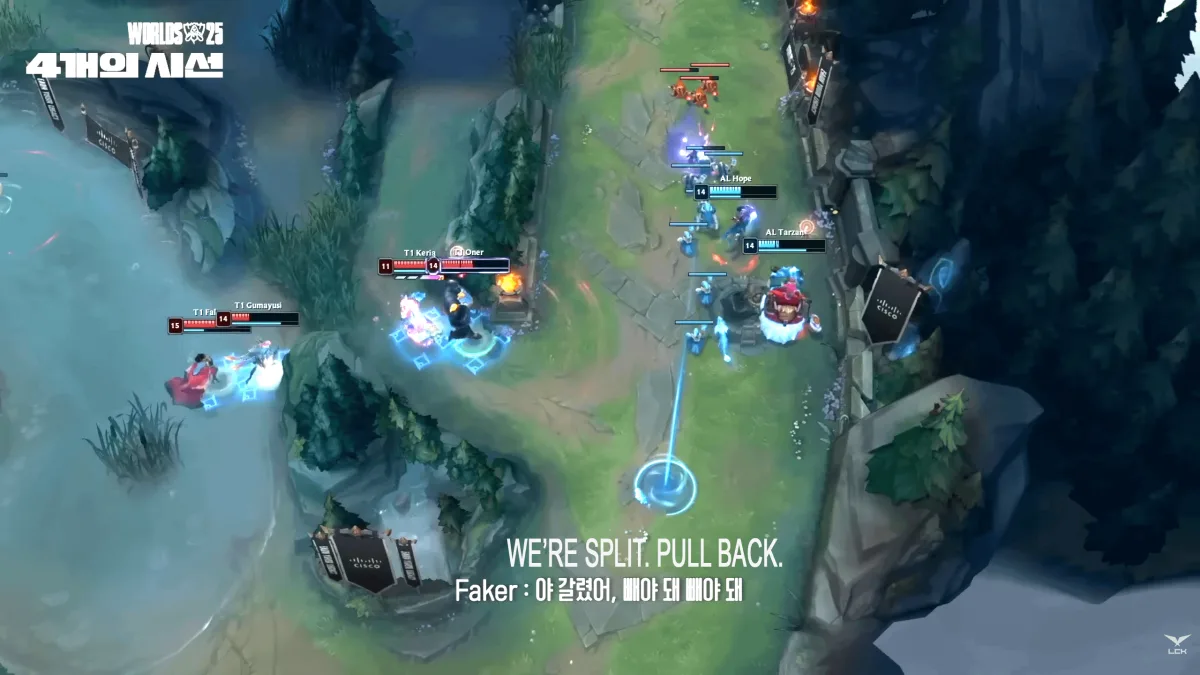
An official LCK video documenting T1’s Worlds 2025 championship run has sparked controversy over how it portrayed a key in-game mistake. Fans reviewing the footage discovered that voice communications were desynced from the gameplay by several seconds in a way that fundamentally changes who appears responsible for the misplay.
The segment in question shows a late-game teamfight involving Faker, Gumayusi, Oner, and an enemy Aatrox. In the original match, analysts and community breakdowns widely identified Gumayusi’s positioning as the primary error that led to the team advancing into a dangerous fight.
The LCK’s edit presents a different story. Voice lines are placed over the wrong moments in the replay to make it appear that Faker was calling the risky plays while Gumayusi correctly followed instructions. The audio timing doesn’t match the visual action, with certain phrases appearing several seconds out of sync with what’s happening on screen.
This matters because Gumayusi himself previously acknowledged his mispositioning in that specific fight during other interviews. The LCK video downplays his responsibility while shifting perceived fault toward Faker and other teammates.
The editing technique isn’t new. Sports documentaries regularly rearrange dialogue to create cleaner narratives. Netflix’s Drive to Survive famously stitches together lines from different races to manufacture drama. Riot esports videos have featured desynced comms before, including during some of Faker’s most iconic plays.
What makes this case different is the context. These aren’t generic production mistakes. The specific way the audio is rearranged changes the tactical decision-making and blame assignment for a high-stakes Worlds moment involving players whose careers depend partly on public perception.
The timing feels particularly pointed given Gumayusi’s history with T1. During a previous season, the organization benched him without clear explanation in favor of rookie ADC Smash. Fans sent support trucks to T1’s headquarters protesting the handling of Gumayusi’s benching.
One truck message translated roughly to “I came to see my dazzling Gumayusi, not him being counted out.” Despite later online framing, these trucks weren’t hate campaigns against Smash. They demanded better treatment and transparency for Gumayusi from T1 management.
The documentary edit now appears to favor Gumayusi in a contentious moment by reassigning responsibility to other T1 members. Some fans view this as deliberate narrative shaping as the LCK looks to build new stars beyond Faker’s eventual retirement. Others see it as sloppy editing or standard documentary practice taken too far.
Building tomorrow’s storylines today
The LCK and Riot have clear incentives to develop the next generation of marketable stars. With Faker approaching the twilight of his career, organizations need new faces and rivalries to sustain viewer interest.
Post-Worlds videos serve this purpose by establishing emotional storylines and highlighting breakout performances. The practice isn’t inherently problematic. But when editing choices materially misrepresent who made which calls during crucial plays, it crosses from storytelling into revisionism.

