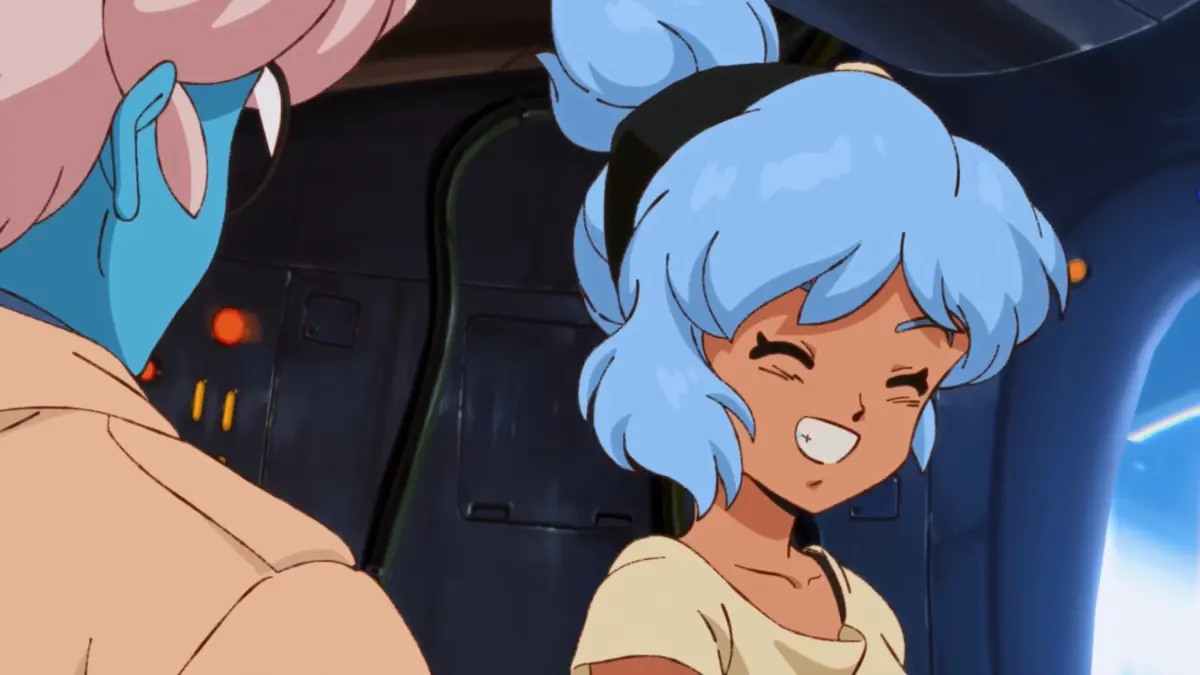
A new Switch 2-exclusive co-op game was revealed at The Game Awards yesterday, toting a 90s anime OVA look and feel. Developed by Shapefarm, Orbitals sees players team up to explore a bright and colorful sci-fi setting that seems far removed from similar anime-inspired games releasing at the moment.
The trailer highlights a distinctive visual approach that mimics hand-drawn cel animation from the late 1980s and early 1990s. Characters feature flat, bold colors that pop against more textured and painterly backgrounds. The 3D presentation is deliberately designed to read as traditional 2D animation in motion.
The game appears built around two-player co-op, though exact details about online functionality and additional player support remain unconfirmed. Local couch co-op is clearly a priority based on what was shown from the heavy emphasis on split-screen.
The visual style draws from classic anime aesthetics of the era. Think Sailor Moon character designs mixed with the OVA production feel of shows like Macross. The technique involves careful use of cel-shading and non-photorealistic rendering to achieve that authentic look.
This puts Orbitals in the same space as other games that successfully replicate 2D animation in 3D. Arc System Works set the standard with Guilty Gear Xrd‘s groundbreaking approach. More recently, Hi-Fi Rush proved stylized visuals can define a game’s identity.
The exclusivity angle raises questions about the arrangement. Platform exclusives at new hardware launches typically involve development support or marketing deals with the console manufacturer. Whether this is permanent or timed exclusivity isn’t clear from the trailer’s wording alone.
A technical achievement worth watching
Pulling off convincing anime aesthetics in real-time 3D requires specialized rendering pipelines. The character rigging needs to hold up from multiple angles while maintaining that hand-drawn feel, which is hard to do in a 3D plane.
Gacha games such as Genshin Impact and Wuthering Waves have led the charge in perfecting this kind of aesthetic, leaning into the exaggerated features of manga and anime. Orbitals, though, seems to be pushing the envelope further to encapsulate a specific period in time, harkening back to a VHS era.

