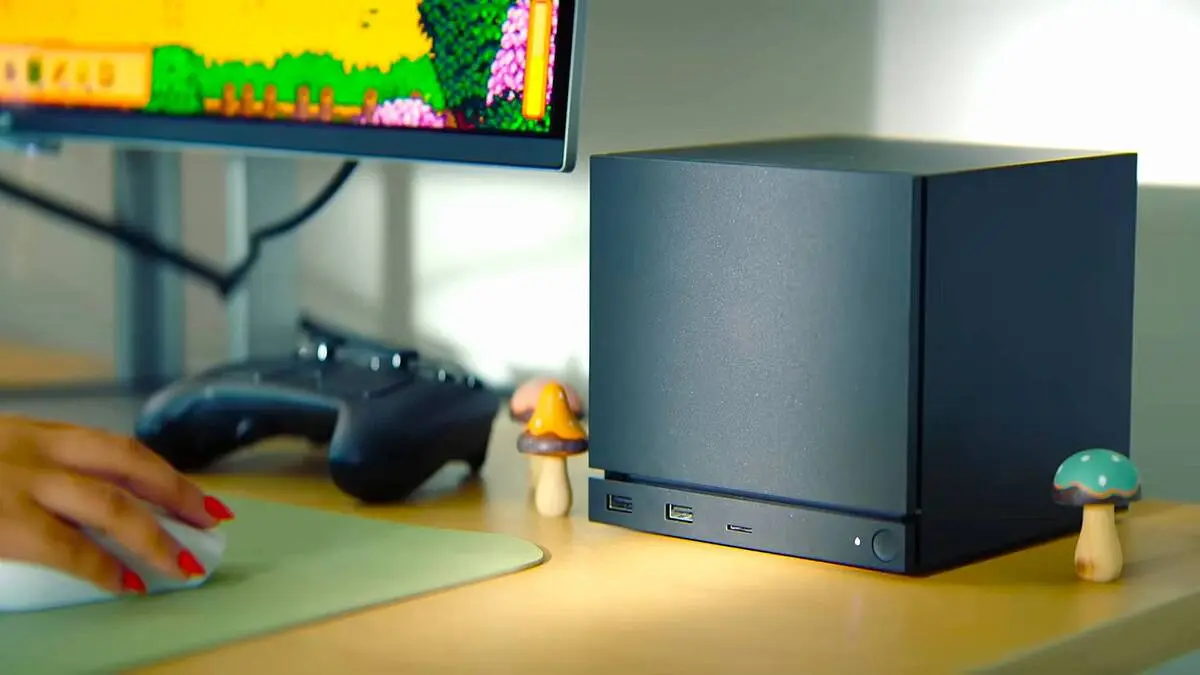
Valve has publicly confirmed that its upcoming Steam Machine will be priced like a gaming PC with equivalent hardware. The device will not be sold at a loss and subsidized through software sales like traditional consoles.
The confirmation came through recent interviews and a Friends Per Second podcast episode where Valve staff explained their pricing approach. The Steam Machine will cost roughly what consumers would pay to build or buy a prebuilt PC with the same CPU, GPU, RAM, and storage.
Valve has not announced exact pricing yet. But based on the confirmed specs, the device will likely land significantly above current console prices.
The Steam Machine packs semi-custom AMD hardware. The CPU is a Zen 4 chip with 6 cores and 12 threads running up to 4.8 GHz at around 30W. The GPU is an RDNA 3 design with 28 compute units and 8GB GDDR6 memory running at 2.45 GHz sustained with 110W TDP. The system includes 16GB of DDR5 RAM and comes in 512GB or 2TB SSD configurations.
PC builders trying to match these specs with current retail components estimate the core parts alone cost around $765. A complete build with motherboard, case, power supply, and cooling pushes toward $900 to $1,000. Some builders claim they can approximate the performance for $560 to $700 with aggressive part selection, but those builds sacrifice the small form factor and integrated features.
Valve explained why they cannot follow the console subsidy model. Since the Steam Machine is a fully functional PC running SteamOS, users can wipe it and install Windows or Linux. They can repurpose it for non-gaming tasks or simply never buy games through Steam.
If Valve sold the device at a steep loss, organizations could bulk purchase them as cheap workstations and never generate the software revenue needed to recoup the hardware subsidy. This differs from traditional consoles, which are locked platforms that guarantee the manufacturer gets a cut of every game sale and subscription.
The Steam Deck avoided this problem because its handheld form factor makes it inherently gaming-focused. The Steam Machine, being a standard small-form-factor PC, faces different economics.
Performance-wise, the GPU sits somewhere below an RX 7600 desktop card and likely trails the PS5 and Xbox Series X in raw graphics power. The device should handle 1080p at 60fps comfortably and manage 1440p with upscaling technologies like FSR. It will not compete as a 4K gaming powerhouse.
The system outputs via DisplayPort 1.4 and HDMI 2.0. It supports features like suspend and resume, HDMI-CEC for TV control, and boots directly into a controller-friendly interface. The compact design fits under a TV like a traditional console.
The hardware market adds pressure
Current memory and storage prices complicate Valve’s pricing strategy. DRAM costs have more than doubled in recent months due to AI datacenter demand. Some DDR5 kits that sold for under $90 in 2023 now cost over $200. SSD prices are climbing similarly.
This supply crunch means Valve faces higher component costs than they might have a year ago. The company likely cannot hit mass-market pricing without accepting significant per-unit losses, which their business model cannot support.
The Steam Machine releases into a market where the PS5 sells for $499 and offers strong exclusive titles backed by years of platform development. Valve’s device offers PC flexibility and access to Steam’s massive library, but at an expected price point of $650 to $900, it targets a different buyer than budget-conscious console shoppers.

