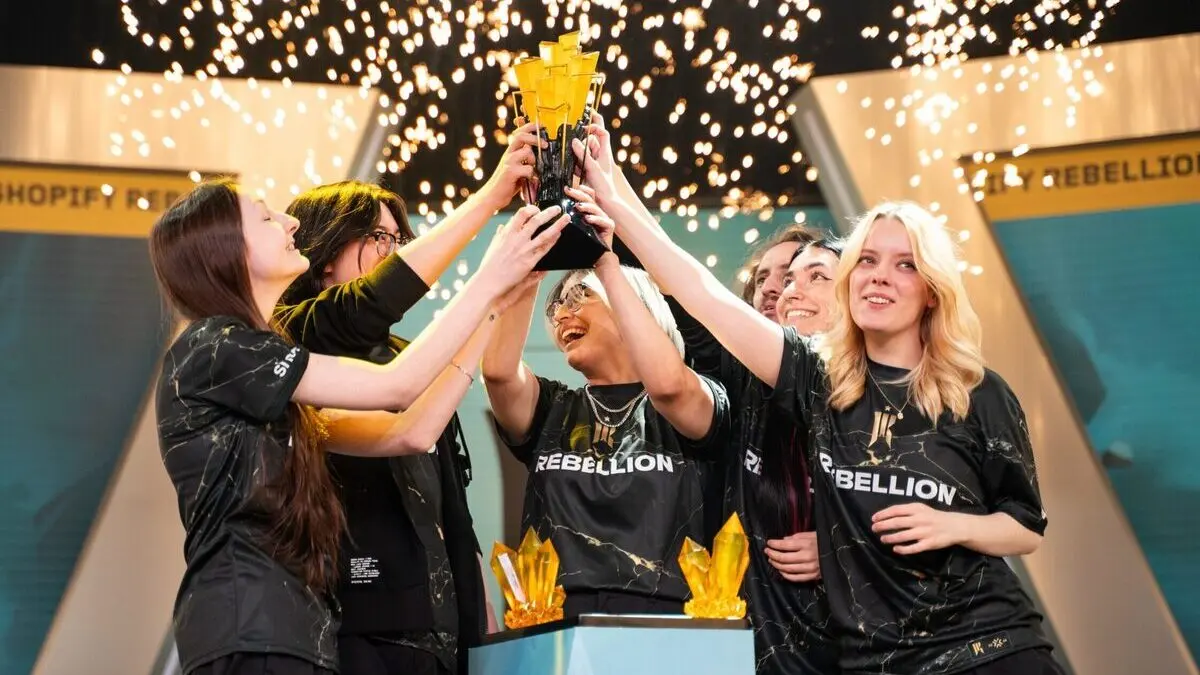
The esports industry has never been bigger. By 2025, it’s expected to hit around $3 billion, with major events like League of Legends’ Worlds drawing in millions of viewers. But behind the massive prize pools and sold-out arenas, one thing remains obvious: the pro scene still doesn’t reflect the players who make up gaming’s global community.
Women account for 31% of active esports players in 2024, yet that balance disappears the moment you step into top-tier esports. All-male rosters dominate every major title, while female lineups and mixed teams barely get any visibility.
And it’s not for lack of talent. Players like StarCraft’s Scarlett and Overwatch’s Geguri shattered the idea that women can’t compete with the best men in the world. Research shows no physical edge separating male and female esports athletes, yet the professional scene still doesn’t reflect the diversity of the player base because of barriers far beyond ability.
The early trailblazers
Women have always been part of competitive gaming, even if their presence wasn’t always visible. In the fighting-game and arcade scenes of the 2000s, several women not only competed but regularly beat their male opponents. Just like Marie-Laure “Kayane” Norindr, who ranked top three in 42 fighting games tournaments by 2011.
As she told ESPN in 2019, “I had to prove myself at a very young age at a time women weren’t competing at all and I was one of the first ones.” Her story reflects a broader pattern: even with exceptional skill, women often had to work harder to be taken seriously in competitive gaming.
StarCraft II introduced another icon: Canada’s Sasha “Scarlett” Hostyn. She won major tournaments against the best male players in the world, eventually becoming the highest-earning female esports player in history according to Guinness World Records.
Scarlett even made history in Korea as the first woman ever to defeat a male opponent in a pro StarCraft II match on Korean TV. Yet even her huge wins mostly made headlines for being exceptional, underscoring how rare it still was for women to crack top events.
High-profile female pros remained exceptions. In Overwatch, Kim “Geguri” Se-yeon overcame false “cheating” accusations after dominating tournaments. Soon after, Geguri was picked up by the Shanghai Dragons, becoming the first woman signed to an Overwatch League team.
The myth of a biological gap in esports
One of the biggest misconceptions around women in esports is the idea that men are simply wired to perform better. But research keeps showing that this belief doesn’t hold up. When scientists look at how players actually perform in games, the data points in one clear direction: there’s no inherent biological advantage separating male and female competitors.
A study from the University of California Davis examined player data from two large MMORPGs and found that women progressed through the game just as quickly as men when accounting for time played.
Another study focusing on spatial cognition, often cited as a reason men might excel in competitive games, showed no meaningful difference between the sexes in map reading or spatial awareness, two skills that are central to high-level play.
In fact, researchers note that unlike traditional sports, “physical attributes are unrelated to high performance in esports, allowing both men and women to compete in the same events.” In short, there’s no genetic advantage in clicking or aiming, and no reason to separate men and women in esports.
Broader research backs this up. A systematic review of challenges faced by women in esports points toward social dynamics, not physical limits, as the main barrier to equal representation. Factors like harassment, gatekeeping, lack of institutional support, and fewer role models have a far deeper impact on who reaches competitive tiers than anything happening on a biological level.
League of Legends’ Lee “Faker” Sang-hyeok says it best. Speaking at the 2025 LoL Worlds press conference, the three-time champion noted something that shouldn’t be controversial: “I believe one of the great strengths of games is that men and women can play without physical differences becoming an issue.” He added that as more women play, he hopes to see them “in incredible matches in the future.”
All this evidence leads to a simple conclusion. Women aren’t underrepresented at the top of esports because of ability: they’re underrepresented because the environment around them hasn’t caught up to the reality of who plays games today.
The real issue of being a woman in esports
While some professional esports players like Faker encourage more women to join the competitive gaming scene, some still seem to believe women’s place is in the kitchen.
FlyQuest’s Elias “Bwipo” Lipp said on stream that “women don’t play competitively” and blamed “menstrual cycles” for any hypothetical drop in performance. The backlash was immediate. FlyQuest suspended him and fined him $20,000, making an example of that backward take.
Many women recount being pushed away long before a pro tryout. WoW’s Raiders.IO GM Kelsey Cox explains that girls often “are discouraged from playing video games” and that “it’s getting better, but it’s still considered a boy’s activity.”
Those who still pursue their love for esports often face harassment. Team Liquid writer Bonnie Qu notes that gender-based harassment is “one of the biggest reasons why people of marginalized genders give up on pursuing gaming professionally.”
I have never made a more desperate plea that what I am about to say right now. @riotgames @RiotSupport I need you guys to fucking do something. I am an incredibly strong person and I have been streaming for a very, very long time. But absolutely nothing prepares you for someone… pic.twitter.com/Gr77uBsBrT
— TaylorMorgan (@TaylorMorganS_) May 13, 2024
Women in esports describe bracing for misogynistic taunts from rivals, teammates, and trolls alike. Victoria “Saffrona” Winn, an Overwatch pro, pointed out that “competitive games have a reputation for being unwelcoming, full of harassment and toxicity,” which drives many women away before they try to reach the highest competitive ranks.
According to Amelie Canet, who leads branding at Vitality, “the esports ecosystem is evolving, but there is still a long way to go. Women’s representation continues to be a challenge, both in professional gameplay and across the broader industry.”
Teams aren’t fans of mixed rosters
In traditional sports, physical differences often justify separate men’s and women’s divisions. There’s no such thing in esport, and yet, men and women rarely play together.
By the official rules of games like League of Legends, any player, regardless of their gender, can join a pro roster. Yet today, there are still almost no mixed-gender teams in major leagues, and most women compete in women-only events.
The esports world was built around a mostly male player base, even if the dynamic has changed since then. Women face hurdles at every stage. G2 Hel’s star AD Carry Maya “Caltys” Henckel explained that public scandals like the Bwipo comments are just “the tip of the iceberg,” as most obstacles happen behind the scenes.
Girls often drop out early due to online harassment or lack of encouragement. Those who persist struggle to get on teams: even top female players report being turned away from male teams simply for being women.
“If you want to join a roster and one or two people, maybe not even the players, don’t want you because they think you are a risk because of your gender, then that’s usually enough to dismiss you,” said Caltys.
AnnaFUT, a content creator who specialises in EA FC, highlights the issue in sports games: “women can compete at the same level as men, so why are women not given the same opportunities to compete at those higher levels?”
Attempts at integration have been limited and inconsistent. In 2021, Evil Geniuses fielded a mixed Valorant roster, but it eventually separated into a women-only team. Red Bull’s mixed-gender invitational events, like Instalock, remain more of an exhibition rather than a season-long commitment.
Creating a more inclusive esports scene
Women-only tournaments and circuits have been created to give players a supportive space to improve and showcase their skills. The North American Scholastic Esports Federation notes that women-only brackets “eliminate [discomfort] and provide women with an opportunity to compete and gain confidence in their abilities”.
Organizations have begun fielding all-women rosters, like CLG Red (CS:GO), Cloud9 White (Valorant), and T1 Blue (LoL). Publisher support has increased, with Riot Games launching Valorant’s Game Changers, a global league for women and non-binary players with support from big brands like Red Bull and Visa.
Valorant is even testing the next step: Riot announced that it will “test mixed-gender tournaments.” The idea is to have Game Changers rosters compete alongside traditional teams, for better representation of the top talents in Valorant, no matter their gender.
Team Liquid Brazil’s all-women Valorant squad showed it’s possible to compete with male rosters. In 2023 TL Brazil became the first Game Changers team in any region to reach a closed qualifier for the Valorant Challengers circuit.
Other games have also pushed for a more inclusive esports scene. Mobile Legends: Bang Bang, a mobile MOBA widely popular within Southeast Asia, supports one of the biggest women’s esports competitive scenes. The MLBB Women’s Invitational 2025 featured a 16-team international lineup and a $500,000 prize pool, one of the biggest in women’s esports history.
Counter-Strike has also developed a solid infrastructure for female players, especially with the ESL Impact and the IESF Female World Esports Championships. In 2023, CS:GO accounted for 23.4% of the total prize pool share allocated for women’s esports. But female tournaments still struggle to attract sponsors, and the ESL Impact came to an end in 2025 as “the economic model is simply not sustainable.”
While not all esports titles have dedicated women’s tournaments or mixed rosters, the trend seems to favor inclusion. G2’s Caltys stated that “you need to have female role models in the scene to encourage women to play,” and events like Valorant’s Game Changers and the MWI could inspire a new generation of players.
The women-only league trap
Women-only leagues were built out of necessity. In games where voice chat can feel like a minefield and ranked lobbies turn hostile the moment someone hears a female voice, these leagues offer a crucial safe place. They give women a place to play, compete, and be seen, without constant harassment or scrutiny.
But here’s the catch: these leagues, while safe, are also sealed off. By isolating female players from the main ecosystem, they create a ceiling on how far anyone can actually rise. You can dominate Game Changers or win an ESL Impact title, but if you’re not scrimming the top 20 teams in the world, and if you’re not getting that exposure to elite-level play, you’re not developing at the same pace as other pros.
It’s not that women aren’t capable of competing with men. It’s that the structure doesn’t let them get there.
You can’t become the best player in the world by spending your entire career inside a bubble. Smaller talent pools mean fewer elite teammates and fewer opponents who push you to your limit. That kind of high-pressure refinement is what creates world-class players. And right now, the system that protects women from the worst parts of esports is also the one that keeps them from breaking into the best parts of it.
Women-only leagues are essential, as they give women the chance to compete without being dismissed, doubted, or harassed before they’ve started playing. But those same protective spaces also create extra steps that men never have to take.
Even with initiatives like Game Changers aiming to bridge the gap, women still face a longer, slower path toward being scouted, scrimming top teams, and proving themselves at the highest level. In an ecosystem where male players are judged purely on skill, women are judged on skill and their ability to navigate a system not built for them.
Still, the path isn’t closed for women who want to compete at the highest level, and new initiatives are beginning to shine a light on the talent that’s been overlooked in women’s esports.
A new era of female role models
Change is also happening from within esports organizations. More women are taking leadership roles, challenging the mostly male-dominated esports industry. Susie “Hotba” Kim made history as the GM of New York Excelsior when they won Overwatch League Season 1. G2 Esports COO Sabrina Ratih and Team Vitality Brand Diversification Director Amelie Canet are also proving that their gender doesn’t influence their abilities.
The growing presence of women in top-level leadership shows that esports isn’t just a boys’ club. From 2019 to 2023, Nicole LaPointe Jameson served as CEO of Evil Geniuses. She steered the organization through a major rebuild and pushed for inclusion with one of the first mixed-gender Valorant rosters. Her position as the first Black woman to run a major esports organisation marked a turning point for representation in the industry, even if it’s still widely dominated by males.
Team Vitality’s Amelie Canet notes that “the esports ecosystem is evolving,” citing “encouraging” new investments in women’s initiatives, even as she warns that “structural barriers remain, from recruitment challenges to online toxicity.”
What’s next for women in esports
Despite the gains, both women and allies stress that the work isn’t done. Even as Faker says games erase physical gaps, Bwipo and others remind us there’s a social gap to bridge.
Several pro-organizations have vowed to support women. FlyQuest donated Bwipo’s fined prize money to women’s programs, and teams like G2 now run full women’s rosters in LoL and Valorant. Publishers are organizing more inclusive tournaments, with Valorant and Mobile Legends: Bang Bang’s Moonton leading the charge.
For now, women’s esports is on a fragile upswing. New tournaments and official backing, like Valorant’s 13% prize-pool share for women’s events, are encouraging. But challenges remain: viewership for women’s events still lags behind, sponsors are slower to commit, and many talented players still find doors closed to the top tier.
Esports is evolving, but at a slow pace. One of the most effective ways to accelerate that change is simple: support the competitions that already exist. Whether it’s Valorant, Counter-Strike, League of Legends, or any other title, tuning into women’s events boosts viewership, attracts better sponsors, and shows publishers that these spaces matter.
Creating a healthier ecosystem also starts at home: on Discord, on stream, even among teammates. Too many women still hear the same tired insults, from “go back to the kitchen” to outright misogynistic slurs.
Shifting that mindset is essential. When players are judged on gameplay rather than gender, the entire scene moves closer to the inclusive, competitive space it claims to be.
