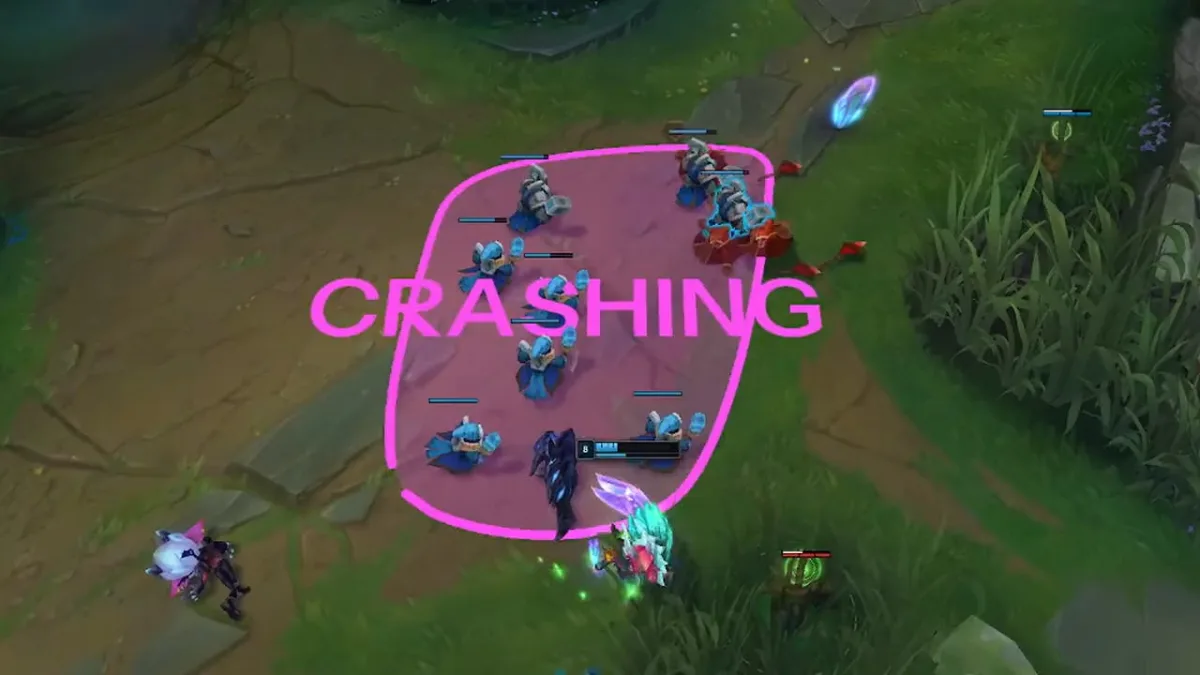
A developer has demonstrated a work-in-progress League of Legends analysis tool that draws gameplay information straight into match replays, starting with the one thing most players never learn properly: wave states.
The tool watches minion waves and labels what they are doing. Pushing, crashing, bouncing, freezing: it puts the state on screen instead of making you squint at the minimap and count melee minions by hand.
According to the creator, the classification isn’t just a headcount. The system looks at the total stats of the minions in a wave, including current health, attack damage, and movement speed. It then checks the next incoming wave on the other side, predicts where the two waves will meet, and factors in any structure standing in the way, like a turret.
The developer says minion stat modifiers from the game state are included in the calculation and admits the classifier is still being worked on. Users spotting mistakes are encouraged to report them.
Replays only, no live overlay
The creator was blunt about scope: this runs in replays, spectator-style review, and on a companion website. It isn’t an in-game overlay telling you what to do while you play.
Asked whether it could work in real time, the developer said that would “100%” be considered cheating. Asked about account safety, they said the tool only runs in replays or through the website, offers no live gameplay assistance, and uses the same tech stack as the team’s existing broadcasting tools, which they consider compliant with Riot’s anti-cheat setup. Riot hasn’t publicly commented on the project.
The team isn’t new to this. They previously built broadcasting tech and an in-world telestrator for BlueBottle.gg and reused parts of it here. The creator says the group wrote its own API rather than leaning only on Riot’s standard post-match endpoints and prefers direct game data, deterministic algorithms, and clustering over feeding a handful of data points to a generic AI and calling it coaching. Machine learning may still be used for concepts that rules can’t capture cleanly. How the replay data is actually pulled wasn’t explained.
The stated philosophy is to visualize evidence, not hand out verdicts. Wave states, tempo, trades, vision, and positioning cues get shown. The player decides what the right play was. The developer says something should only be labeled a mistake when the data is certain enough, since saving Flash, delaying a recall, or holding gold can all be correct depending on the matchup and map.
Roam tracking is already in, including whether a player left lane, whether it worked, and how much CS they gave up. Recall timing is planned early. The developer says the data could also cover skill shot hits and misses, last hits, health, vision, attack range, and trading patterns.

