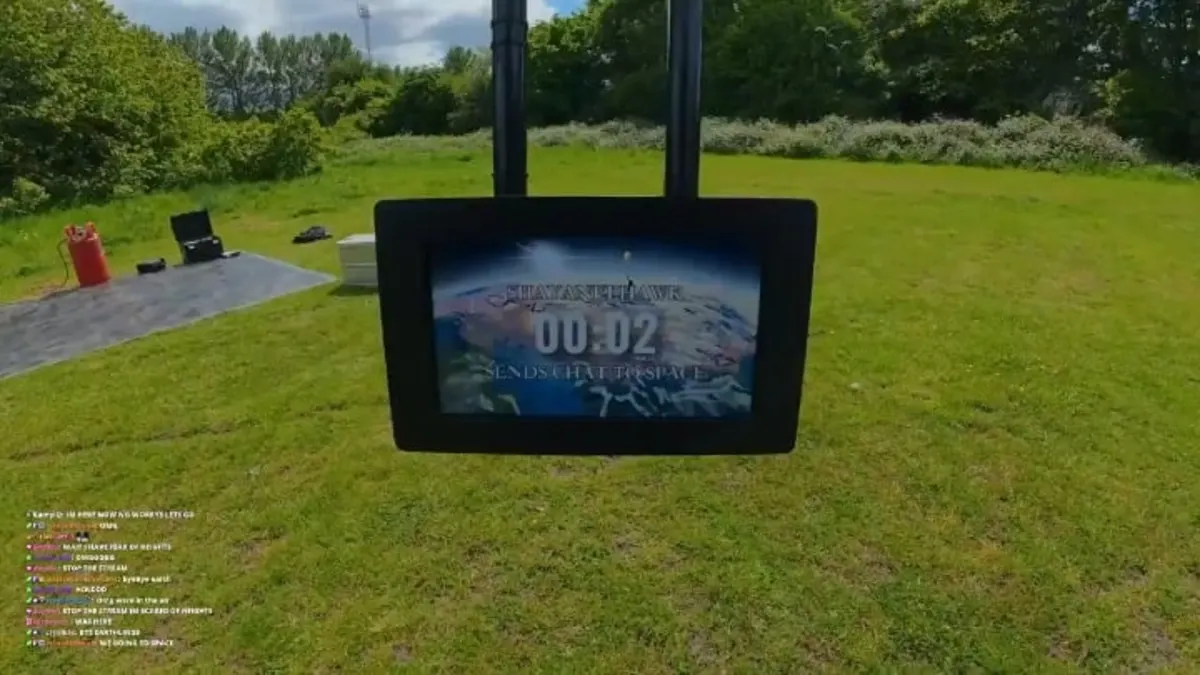
Shayanelhawk pulled off a flashy stunt this week, airing footage of a high-altitude balloon carrying Twitch chat into the upper atmosphere. The clip took off online as “the first chat sent into space on stream.” The reality is a bit more grounded.
According to viewers who went back through the VOD, the footage wasn’t live. A weather balloon company sent the payload up, recorded the ascent, and Shayanelhawk played the video back during the broadcast. The chat element shown floating above Earth was also pre-recorded, with chatters effectively roleplaying the moment.
See in Threads
The launch itself was real. The balloon climbed high enough to show Earth’s horizon and the dark edge of the atmosphere, the kind of visuals you get from any hobbyist high-altitude flight that reaches roughly 20–40 kilometers up. That is the stratosphere, often called “near space,” but well short of the Kármán line at 100 kilometers that actually marks outer space.
The battery gave up
The footage also wasn’t flawless. At the 2:40:10 mark of the VOD, the operators emailed Shayanelhawk to explain that the onboard camera lost power after about two hours. They couldn’t strap on a bigger battery because of weight rules on the payload. The ascent got captured. The descent and landing didn’t.
That tracks with how these flights usually work. Cold temperatures drain batteries fast, weight limits force lighter gear, and live video from that altitude is basically off the table for a small payload. Cell coverage doesn’t reach there, and satellite uplinks are too heavy and power-hungry for a hobbyist setup. Pre-recording to onboard storage is the standard play.
A few sharp eyes also pointed out that the dramatic curve of Earth in the clip is mostly the camera lens. Wide-angle and fisheye lenses bend the horizon hard, especially when the payload tumbles.
The “first ever” framing is shaky too. Brands, schools, and YouTubers have been strapping cameras, logos, and messages to weather balloons for over a decade. A Twitch-chat-themed version is a fresh spin, but not a world first.
The project was reportedly self-funded and community driven, with some viewers crediting an ExtraEmily community member for organizing it during her break.

