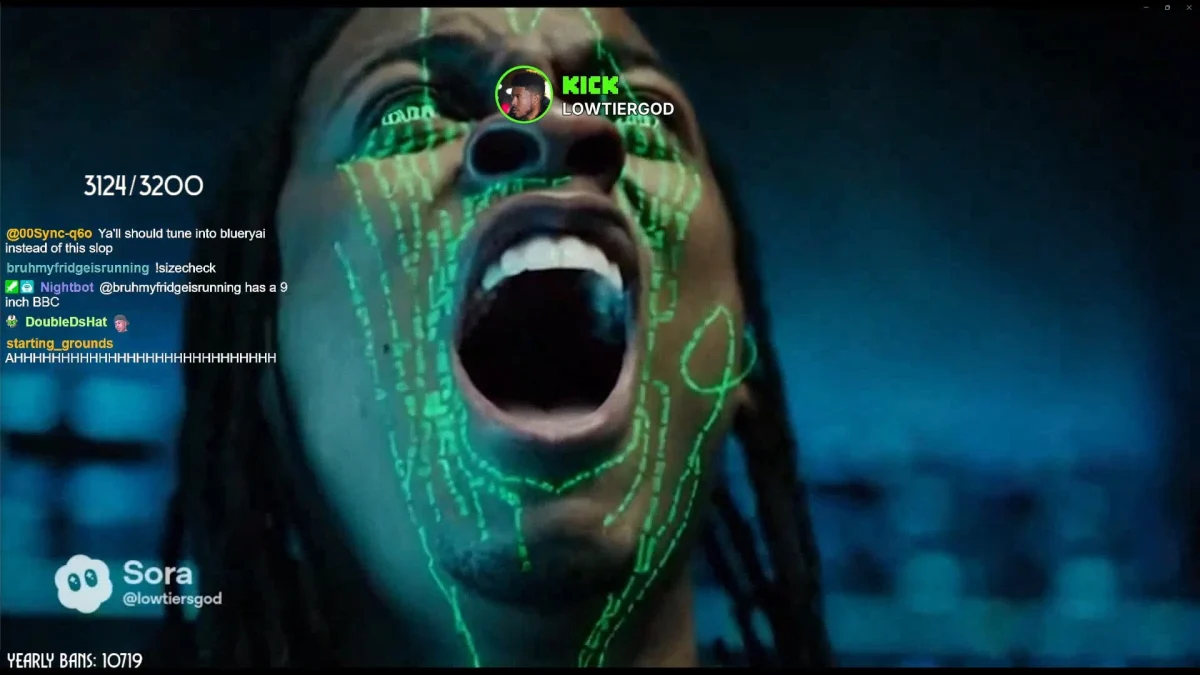
Dale “LowTierGod” Wilson has moved into filmmaking. Sort of.
The fighting game personality premiered an AI-generated project titled Soul Swap, a violent thriller starring a digital version of himself. Clips from the premiere spread fast, and the full thing landed on YouTube shortly after.
The story is simple. An AI likeness of LTG plays a calm, suited mastermind who grabs people off the street and drops them into deadly traps. His captives are Black men, and the film frames several of them as criminals, including a hacker and a car thief. Viewers immediately compared the setup to Saw, with LTG’s character acting as a Jigsaw-style judge who hands out punishment.
The contrast is hard to miss. His character wears a clean suit, speaks formally, and has robot helpers doing the work. The captives speak in heavy slang, with “bruh” and “gang” repeated constantly, even when they are alone and talking to themselves.
Everything on screen appears to be generated, not filmed. No cast, no sets, no camera. Viewers say the movie was built by stitching together short clips reportedly made with OpenAI’s Sora, using LTG’s own face and voice as reference material.
That includes the dialogue. Rather than recording his lines himself, LTG appears to have used an AI clone of his voice for his character.
The face-swapping problem
The result is exactly what current AI video tools produce when you push them past a few seconds. Faces drift between shots. The hacker and the car thief each seem to turn into three different people. Clothes change. Actions start without reason and end without payoff.
To hide it, the film cuts constantly, sometimes every one or two seconds. One viewer joked it had “4,000 cuts per second.” Another said watching it was physically uncomfortable.
Reaction split into two camps. Most people focused on the jank, handing out nicknames like “Soul Slop” and “Low Tier Movie.” Some viewers read the film as racially loaded wish fulfillment, pointing to the stereotyped captives and LTG casting himself as the polished authority figure above them. Others pushed back, arguing there was nothing racist about a Black creator writing Black criminals into a revenge thriller.

