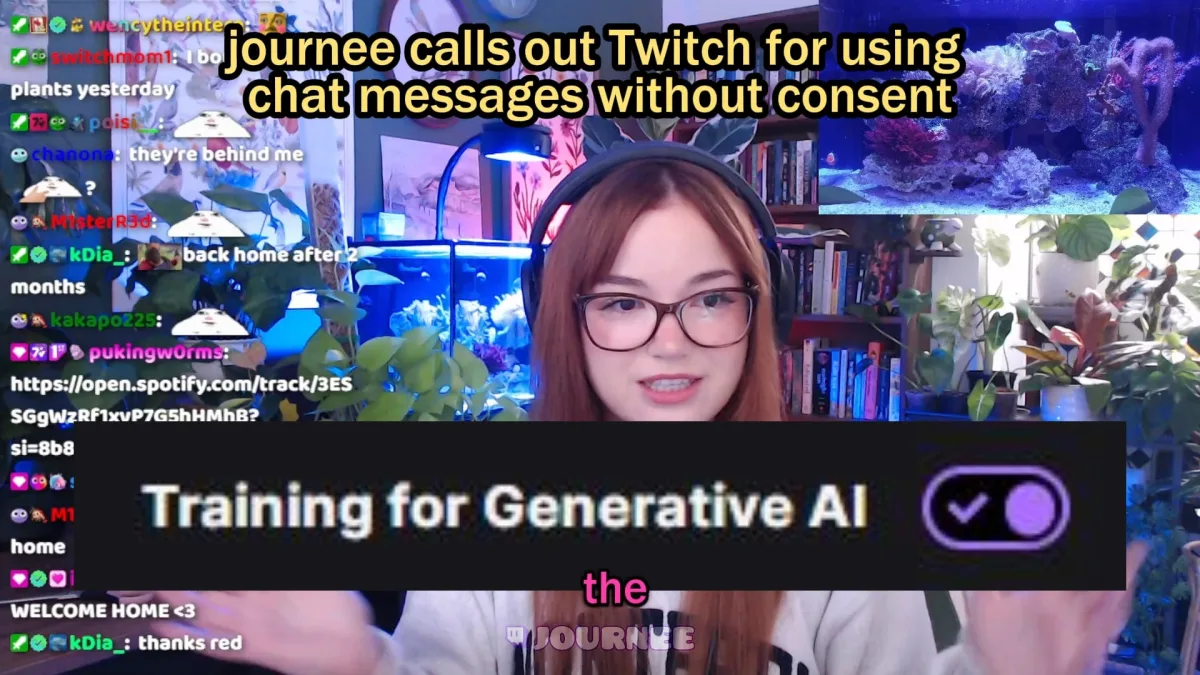
Journee has put a spotlight on a Twitch account setting called “Training for Generative AI,” one that was switched on for users without anyone asking first.
The toggle sits under Settings > Security and Privacy, all the way at the bottom of the page. Click your profile icon, open Settings, scroll down, and it’s there. Plenty of users who checked after her stream reported the same thing: It was already enabled.
Journee’s complaint wasn’t that Twitch collects data. It’s that this particular use was handed out by default, with no separate prompt asking permission.
The setting actually says the following: “Allow your channel content to train generative AI content models at Amazon. Turning this off does not opt you out of Twitch and Amazon using your channel content for other purposes described in the Twitch Privacy Notice, including using AI-supported Twitch features that benefit the community by facilitating streamer growth and monetization (such as real-time sponsorship campaign assistance), viewer discovery (such as recommendations), and community safety (such as AutoMod).”
So this isn’t a “stop collecting my data” button. It only covers generative AI content models at Amazon, Twitch’s parent company. Recommendations, AutoMod, spam and fraud detection, sponsorship tools, all of that keeps running either way.
Twitch’s own FAQ backs this up, arguing some AI systems are baked into running, securing, and moderating the platform, and can’t be switched off account by account.
There’s another catch in the wording: “your channel content.” That suggests the toggle governs content tied to your own channel. What happens to messages you type in someone else’s chat is far less clear, the permission may sit with that channel instead of with you. Twitch hasn’t spelled out who controls what.
Journee also floated theories about chat data being used to make automated chat accounts look more human, potentially propping up inflated viewer counts. Nothing supports that. Twitch hasn’t said the setting has any link to chatbots or viewbotting, and there’s no evidence of data being sold to bot farms.

