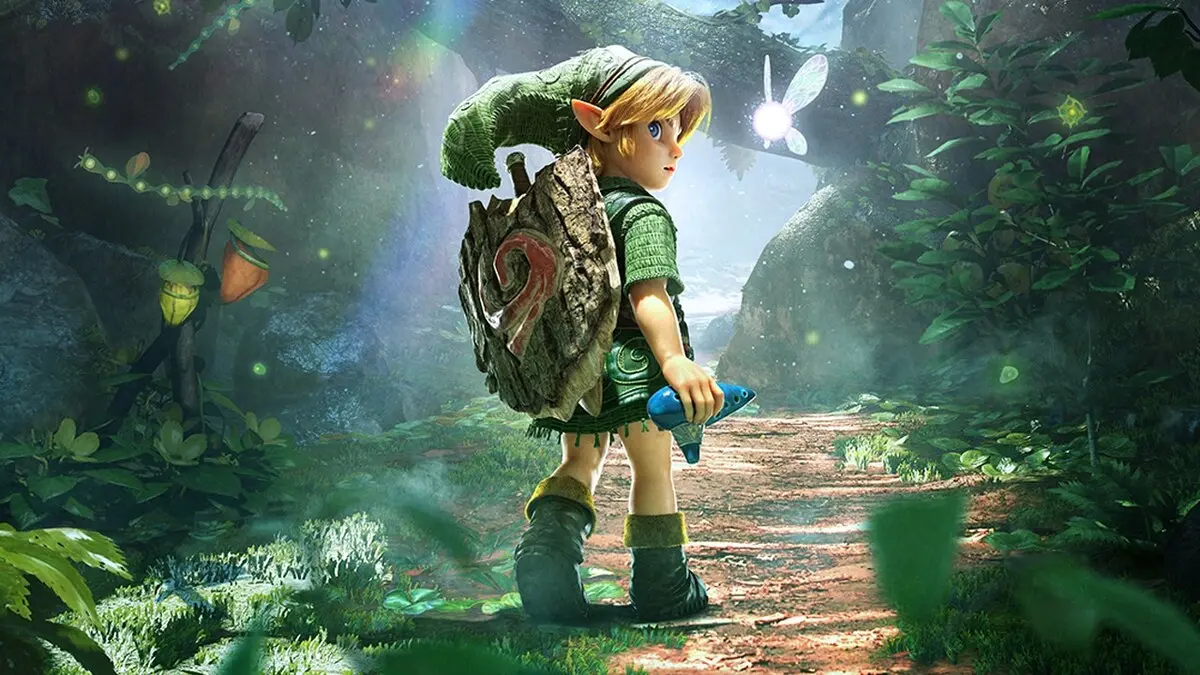
An extended gameplay presentation for the Ocarina of Time remake has landed, and it gives the clearest look yet at how much of the 1998 classic has been rebuilt, and how much has been left exactly as it was.
The footage follows Young Link from Kokiri Forest into Inside the Deku Tree, then out to Hyrule Field and Castle Town. Every asset looks rebuilt from scratch: new models, new textures, denser vegetation, real lighting, and fog. Link’s tunic, cap, Kokiri Sword, and slingshot all carry far more surface detail than the N64 originals.
What stands out is how little the actual design has changed. Kokiri Forest’s paths and walkways are instantly recognizable. The Deku Tree follows the same route through the same rooms, with familiar enemy placement and traversal beats. Hyrule Field keeps its wide, sparse hub layout.
Castle Town is the exception. It looks noticeably busier, with more Hylians walking around, extra props, more architecture, and at least one expanded street. The destination and story role appear unchanged, it just finally looks like a town instead of a handful of NPCs standing in a courtyard.
The closing montage moves past the opening hours, showing Adult Link, a redesigned Sheik, plus Young Zelda, Impa, Saria, Navi, and Ganondorf. Several of those characters appear to have spoken dialogue, which would be a big shift for a game originally built around text boxes. How much of the script is voiced hasn’t been spelled out.
Modern controls, old-school loading screens
The presentation highlighted a dedicated jump button. That sounds minor until you remember that pre-Breath of the Wild Zelda games handled jumping automatically when Link ran off a ledge. There’s also a free camera, a minimap, and an objective tracker that points Link toward the castle.
Item handling has changed too. Instead of the N64’s three C-button slots, the footage shows a horizontal quick-select row similar to Breath of the Wild and Tears of the Kingdom, with the D-pad holding fixed entries like the Ocarina and Navi. Whether those can be remapped, or the minimap and quest marker switched off, is still unknown.
The remake also keeps the original’s segmented world. Transitions between areas remain, and the presentation reportedly framed that as a deliberate choice to preserve the structure of the 1998 game. Hyrule was never a seamless open world, as Hyrule Field is a hub connecting separate regions, so this is faithfulness rather than a technical shortcut.

